
Skip to content
Applications

Geriatrics

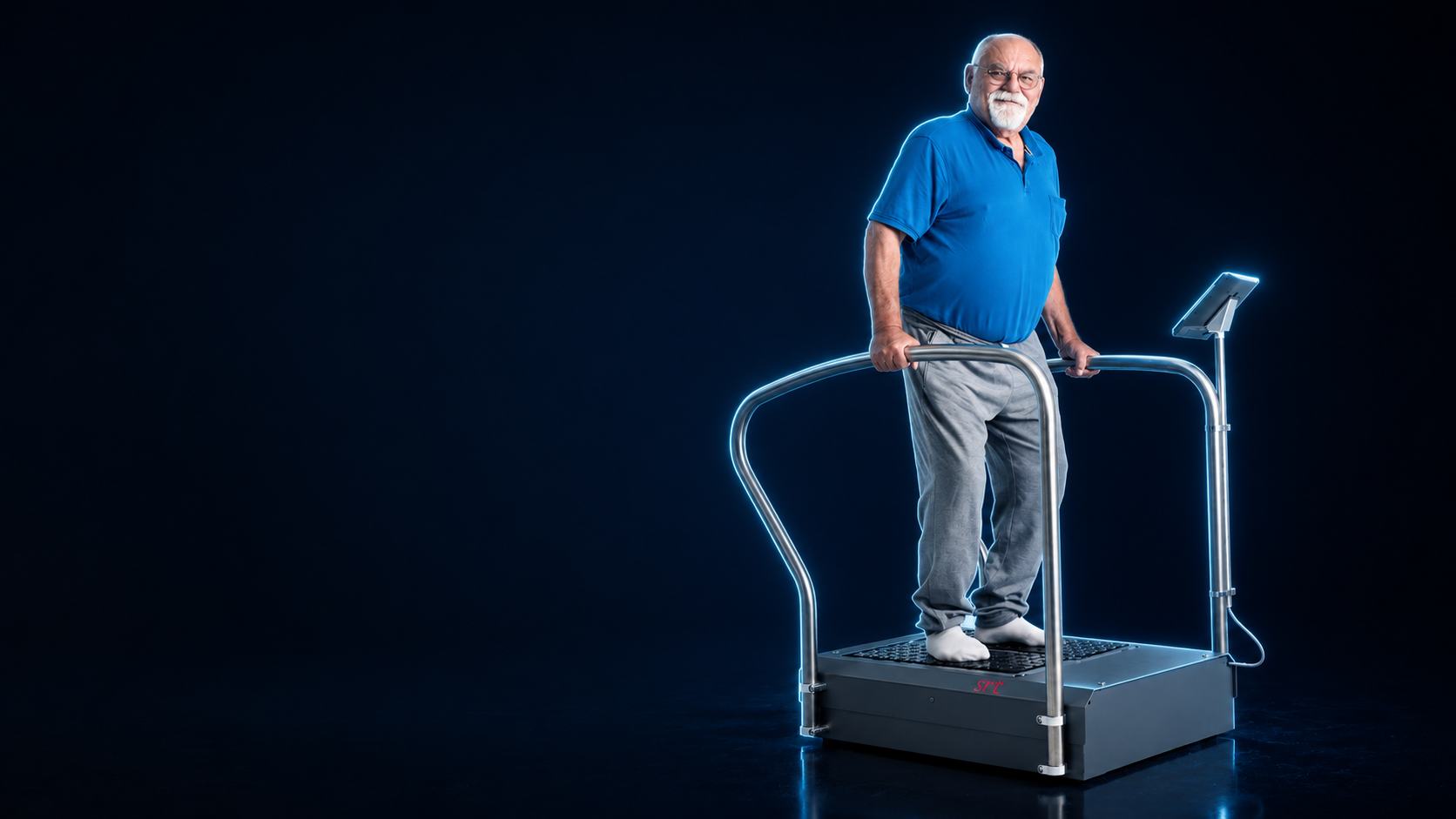
A few minutes standing, with a handrail and individually dosed intensity: a training stimulus that remains accessible even for very old or severely limited people.

Indications

  • 01Fall risk and gait insecurity
  • 02Sarcopenia
  • 03Osteoporosis
  • 04Immobility after hospital stay
  • 05Movement disorders accompanying dementia

Therapy goals

  • Clearly improved balance reactions
  • Preservation of mobility and independence
  • Short sessions, high acceptance

How it works

Safe walking begins in the nervous system — not in the muscle alone.

Ageing processes and motor disorders reduce the ability to control balance — the risk of falling rises sharply. From the age of 75, the consequences of a fall are often severe: fractures, hospital stays, increased morbidity and mortality.

srt zeptoring® is therefore an integral part of modern geriatric therapy: stochastically randomised stimuli train exactly the level at which safe movement is created — sensory signal processing and the reflex control of balance, stance and gait.

The application takes only a few minutes, is performed standing with a handrail and therefore remains accessible even for very old or severely limited people — without major voluntary effort.

Evidence-based fall prevention

Effects on balance regulation, gait pattern and movement confidence documented by studies and field observations.

Quality made in Germany

Highest standards in precision and reliability for reproducible therapy results.

Suitable for the very old

Individually dosed intensity, standing application with a handrail, safe and easy to structure.

Older patient training safely at the handrail of srt zeptoring® for fall prevention

SRT ZEPTORING®

A few minutes standing — with a handrail, without voluntary effort.

Goals of geriatric therapy

Neural control, bone and muscle are addressed together — creating confidence in everyday life:

  • Improved sensory signal processing
  • Greater movement confidence in daily life
  • Improved balance regulation and gait pattern
  • Increased voluntary activation potential
  • Bone preservation and bone building
  • Muscle preservation and muscle building
  • Pain reduction and detonisation
  • Preserving mobility and independence
Neural networks as the basis of balance and gait safety

Used clinically for

  • Fall risk & gait insecurity
  • Osteoporosis
  • Sarcopenia & muscle loss
  • Immobility after hospital stay
  • Dementia
  • Chronic pain
  • Osteoarthritis

Indications in detail

What happens in practice — indication by indication.

01

Fall risk & fall prevention

Many everyday movements have to happen very fast — these are reflexes. They need the right magnitude: every step down triggers reflexes in the leg muscles. If they are too small, body weight cannot be absorbed and a fall occurs; if they are too large, the body moves in an uncontrolled way.

For the reflex to reach optimal magnitude, the receptor-muscle system needs pre-activation — the so-called preflex. The more variable the training stimuli, the better the preflex is set and the more precisely the reflex adapts to the situation.

The stochastically randomised stimuli of srt zeptoring® create exactly this variability and thus optimise preflex-reflex control. In addition, the posterior (hamstring) thigh muscles are activated — known from studies to be decisive for a fluid, safe gait and the prevention of knee injuries.

Observed effects compared with conventional therapy

  • Improved sensory signal processing
  • Greater movement confidence in daily life
  • Better balance regulation and gait pattern
  • Increased voluntary activation potential
30%

better perception (field observation)

02

Osteoporosis & bone metabolism

srt zeptoring® generates multidimensional, stochastically randomised stimuli. Transferred to bone structures, they increase bone metabolism and lead to marked adaptations in strength.

For stimulating bone growth, stochastic resonance stimuli produce roughly fourfold greater growth processes than the low-frequency sinusoidal vibration of conventional devices at the same carrier frequency.

This is attributed to the stochastic behaviour of calcium and other ion channels, which play a central role in the formation of bone cells (osteoblasts).

Observed effects compared with conventional therapy

  • Substantially increased bone metabolism and strength
  • Changed bone structure through multidimensional mechanical stimulation
  • Reflex activation through neuromuscular stimulation
  • Reduced risk of falls and fractures
390%

higher bone growth (field observation)

03

Sarcopenia & muscle preservation

Muscles need stimulation from nerve cells. Without it, muscle mass declines. Many older people cannot activate their leg muscles sufficiently on purpose due to illness or accident — the neural network degenerates.

The fast, stochastically randomised movements of the footplates act as intense stimuli for various receptors. This triggers involuntary muscle activation, counteracts muscle loss and improves voluntary activation — within a few minutes and without overloading.

Observed effects compared with conventional therapy

  • Activation of deep muscle layers
  • Prevention of muscle loss
  • Improved voluntary activation
  • More strength for standing up, walking and stairs

04

Neuroprotection & dementia

Nerve cells need regular activation to survive and form connections. If stimulation is absent for a long time, they die.

The application releases neurotrophic factors. These substances “nourish” nerve cells, promote neural connections and protect against degeneration — relevant in Parkinson's disease, multiple sclerosis and dementia, among others.

Neurotrophic factors respond sensitively to the type of stimulus: release is greatest with stochastically randomised stimuli at a base frequency in the theta range of 3.5 to 7.5 Hz — exactly the configuration srt zeptoring® provides.

Observed effects compared with conventional therapy

  • Release of neurotrophic factors
  • Protection against neural degeneration
  • Promotion of neural connections
  • Better perception and reactivity

05

Mobility, coordination & pain

srt zeptoring® specifically promotes flexibility and mobility so that everyday movements become easier again. Reactivity is strengthened through optimised motor patterns — movements become more fluid and controlled.

Chronic pain and muscular tension can be influenced by the stochastic stimuli, which may contribute to relief. Together with balance training this creates more body stability and the ability to react to sudden movements.

Observed effects compared with conventional therapy

  • Improved mobility
  • Improved coordination
  • Pain reduction
  • Improved balance

Source: Prof. Dr. rer. nat. Stefan Dalichau, Institute of Applied Prevention and Performance Diagnostics, BG trauma clinic and rehabilitation centre at Bremen Airport: “Vibration training in therapy with particular reference to stochastic resonance” (field observations).

Success story

When movement becomes possible without fear again

In geriatric care what counts is not maximum strength or speed, but safety, confidence and feeling at home in one's own body again.

Many of our patients suffer from muscle weakness, balance disorders and a deep-seated fear of falling. Often it is not the actual fall that limits them but the constant caution: movements become smaller, distances shorter, activities avoided. Mobility is gradually lost — and with it a piece of independence.

Conventional training programmes often reach their limits here: some are physically overwhelming, others too superficial. Above all, many measures do not reach the nervous system sufficiently — and that is exactly where it is decided whether movement feels safe or unsafe.

From this observation we looked for an approach that works where balance, reaction and stability are actually controlled. That is how we came across srt zeptoring®. Patients report a more stable feeling when standing, more confidence when walking, less insecurity when getting up or turning — and above all growing trust in their own body.

As the fear of falling decreases, the willingness to move returns. Distances are covered independently, everyday activities are no longer avoided. Mobility returns not as athletic performance but as lived independence.

srt zeptoring® is now firmly integrated into our everyday geriatric therapy. The application is safe, easy to structure and suitable even for very old or severely limited people. In hindsight, integrating it was not a question of modern technology — it was a decision for dignity, safety and quality of life in old age.

Mike MüllerOwner, Röthenbach rehabilitation and therapy practice

Frequent questions

Geriatrics & stochastic resonance

To the study library

How does srt zeptoring® help with fall prevention?

The stochastically randomised movements of the footplates train sensory signal processing and preflex-reflex control. Field observations show around 30 % better perception, greater movement confidence in daily life, improved balance regulation and a safer gait pattern.

Is the application suitable for very old people?

Yes. It is performed standing with a handrail, takes only a few minutes and the intensity is dosed individually. It is therefore suitable even for very old or severely limited people and is set therapeutically or medically.

Does srt zeptoring® work for osteoporosis?

The multidimensional stochastic stimuli are transferred to bone structures and increase bone metabolism. Compared with the low-frequency sinusoidal vibration of conventional devices at the same carrier frequency, roughly fourfold greater growth processes are described (up to 390 % higher bone growth in field observations).

Why is activating nerve cells so important in old age?

Nerve cells need regular stimulation to survive and connect. srt zeptoring® releases neurotrophic factors that “nourish” nerve cells and protect them from degeneration. Release is greatest with stochastically randomised stimuli in the theta range of 3.5 to 7.5 Hz — relevant in Parkinson's, multiple sclerosis and dementia, among others.

How can srt zeptoring® be organised in geriatric practice?

Circuit training has proven effective: short application times fit into existing group and individual therapy. It complements physio- and occupational therapy concepts and often improves the conditions for subsequent gait and everyday training.

Medical device. Use after consulting a physician. The content shown does not replace medical advice.