

Skip to content
Applications

Prevention & training

Prevention is decided by the quality of neuromuscular control: a few minutes of unpredictable stimuli train reaction, joint stabilisation and explosive strength — joint-friendly and without maximum effort.

Indications

  • 01Fall prevention
  • 02Workplace back prevention
  • 03Return to sport after injury
  • 04Coordination and power training
  • 05Recovery in competitive sport

Therapy goals

  • Fewer injuries through better joint stabilisation
  • Measurable progress in balance and power

How it works

Unpredictable by principle — and preventive for exactly that reason.

Prevention is not decided by maximum strength but by the quality of control: how fast, how precisely and how appropriately does the neuromuscular system react to an unexpected stimulus? That is exactly the level srt zeptoring® trains.

The stochastically randomised movements of the footplates are unpredictable. The nervous system cannot settle into a pattern but has to regulate anew in every moment — a thousand different stimuli become one training session for the nervous system.

The result is a training stimulus with high effect density in a short time: reflex activation of deep muscle layers, improved joint stabilisation, greater movement confidence — with low joint loading and without maximum voluntary effort.

Short application, high density

A few minutes produce a large number of involuntary activations — efficient for prevention, corporate health and elite sport.

Joint-friendly

Stimuli work via receptors and reflexes instead of high external loads — usable in recovery and build-up phases too.

Measurable & reproducible

Defined programmes, documented intensities, made in Germany — progress in balance and power becomes traceable.

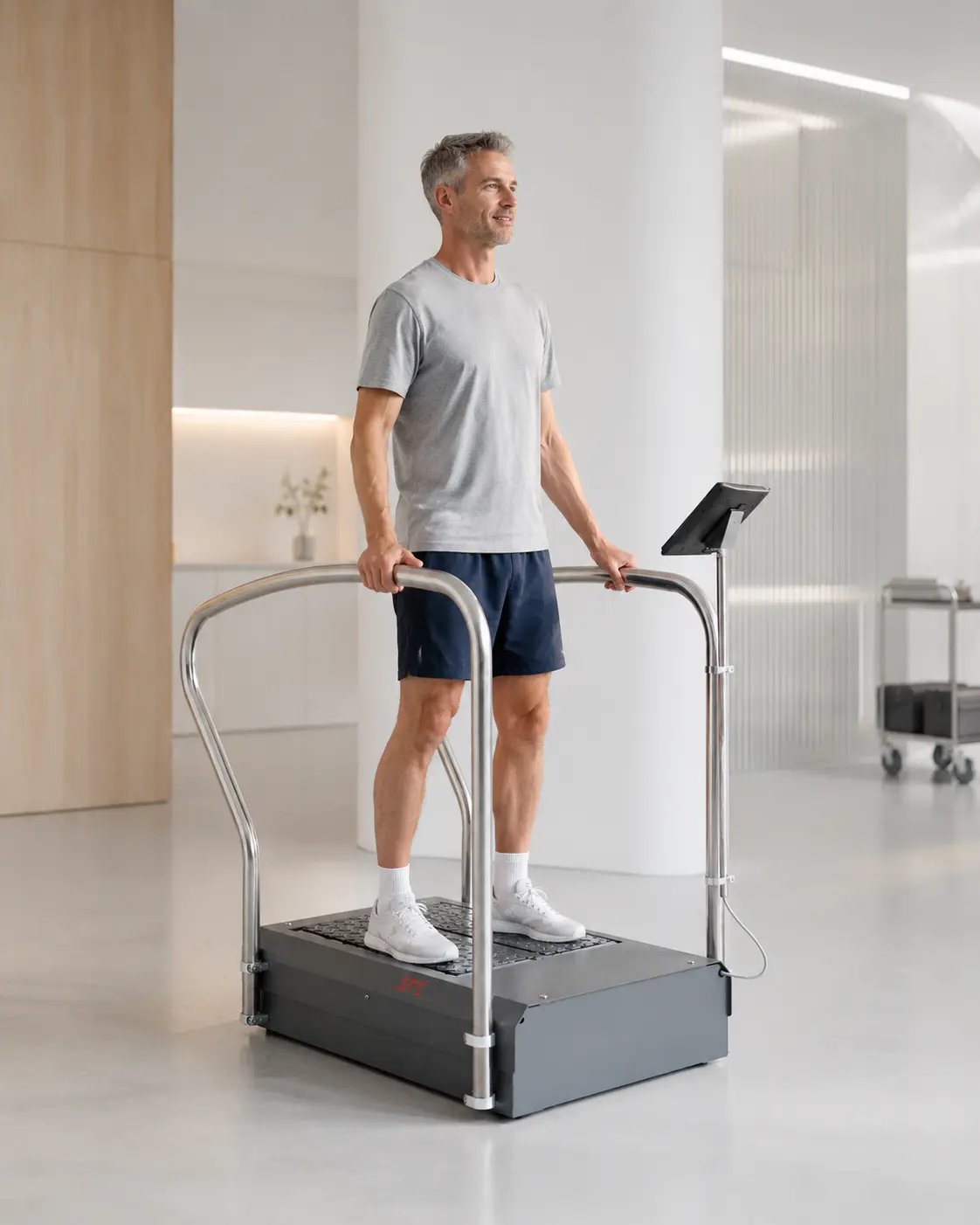
Athlete in preventive training on the srt zeptoring®

SRT ZEPTORING®

A thousand different stimuli are one training session for the nervous system.

Goals in prevention, training and recovery

Control, muscle and bone are addressed together — creating resilience rather than mere strength:

  • Injury prevention through better joint stabilisation
  • Optimised preflex-reflex control
  • Explosive strength and reactivity
  • Trunk stability and postural control
  • Activation of the hamstring muscles
  • Recovery and detonisation after exertion
  • Bone strength and load tolerance
  • Body awareness and movement confidence
Neural networks as the basis of reaction and stability

Used in

  • Injury prevention
  • Workplace back prevention
  • Return to sport
  • Coordination & power
  • Recovery in competitive sport
  • Fall prevention
  • Bone metabolism & osteoporosis prevention

Fields of application in detail

What happens in practice — field by field.

01

Injury prevention

Injuries rarely happen in planned movements but in unexpected ones: rolling an ankle, slipping, landing off balance. What matters then is whether the reflex has the right magnitude — and for that the receptor-muscle system needs pre-activation, the so-called preflex.

The more variable the training stimuli, the better the preflex is set and the more precisely the reflex adapts to the situation. The stochastically randomised stimuli of srt zeptoring® deliver this variability systematically — not as a rhythm but as a constantly changing demand.

Particularly relevant: the application activates the posterior (hamstring) thigh muscles. Numerous studies show that their activation is decisive both for preventing knee injuries and for a fluid, safe gait.

Observed effects compared with conventional therapy

  • Optimised preflex-reflex control
  • Better knee and ankle joint stabilisation
  • Activation of the hamstring muscles
  • Greater movement confidence under perturbation
30%

better perception (field observation)

02

Back prevention & corporate health

Sedentary work weakens exactly the structures that secure the spine: the deep, reflexively working trunk muscles. They can hardly be addressed voluntarily — they respond to disturbances of balance.

The unpredictable movement impulses continuously create small balance disturbances and thus reflexive stabilisation work in trunk, pelvis and legs. At the same time the stimuli have a detonising effect on muscular tension.

For corporate health management, time economy matters most: the application takes a few minutes, is done standing in everyday clothing and produces no training sweat — a low-threshold entry point even for untrained employees.

Observed effects compared with conventional therapy

  • Reflex activation of the deep trunk muscles
  • Detonisation and pain reduction
  • Improved postural control
  • Low-threshold and time-efficient

03

Return to sport after injury

After injuries and surgery it is often not only muscle mass that is missing but the activation: the neural network that recruits the muscles is slowed down by protection and immobilisation. Conventional strength training, however, presupposes exactly that activation.

srt zeptoring® takes a detour: fast stochastic stimuli generate involuntary muscle activation, counteract atrophy and improve voluntary activation — with low loading of joints and structures.

This bridges rehabilitation and performance building: before load is added, control becomes reliable again — a prerequisite for robust explosive strength and a return with lower risk of recurrence.

Observed effects compared with conventional therapy

  • Involuntary activation despite protection
  • Less muscular imbalance between sides
  • Improved voluntary activation
  • Safe transition into load-oriented training

04

Coordination & explosive strength

Explosive strength originates in the nervous system: it depends on how many motor units are recruited, in what order and how synchronously. Stochastically randomised stimuli demand exactly this recruitment — hundreds of times in a few minutes.

Because the stimuli cannot be anticipated, the habituation typical of rhythmic vibration does not occur. The training stays new for the nervous system — and therefore effective across longer training cycles.

Observed effects compared with conventional therapy

  • Improved intermuscular coordination
  • Higher voluntary activation potential
  • Faster reaction to perturbations
  • Efficient complement to strength and jump training

05

Recovery in competitive sport

In high-load phases, every measure that reduces tone without creating new fatigue counts. Stochastic stimuli reduce muscular tension and promote circulation without building up high external loads.

In addition, neurotrophic factors are released — substances that “nourish” nerve cells, promote neural connections and protect against degeneration. Release is greatest with stochastically randomised stimuli at a base frequency in the theta range of 3.5 to 7.5 Hz, exactly the configuration srt zeptoring® provides.

Observed effects compared with conventional therapy

  • Detonisation without additional fatigue
  • Promotion of circulation
  • Release of neurotrophic factors
  • Short sessions between training and competition loads

06

Bone strength & osteoporosis prevention

Bone responds to mechanical stimuli. srt zeptoring® generates multidimensional, stochastically randomised stimuli; transferred to bone structures they can stimulate bone metabolism and support adaptation.

Compared with the low-frequency sinusoidal vibration of conventional devices at the same carrier frequency, roughly fourfold greater growth processes are described — attributed to the stochastic behaviour of calcium and other ion channels, which are central to the formation of osteoblasts.

Observed effects compared with conventional therapy

  • Increased bone metabolism
  • Improved load tolerance of structures
  • Prevention of osteoporosis and stress fractures
  • Training stimulus without high external loads
390%

higher bone growth (field observation)

Source: Prof. Dr. rer. nat. Stefan Dalichau, Institute of Applied Prevention and Performance Diagnostics, BG trauma clinic and rehabilitation centre at Bremen Airport: “Vibration training in therapy with particular reference to stochastic resonance” (field observations).

Frequent questions

Prevention, training & stochastic resonance

To the study library

How does srt zeptoring® differ from conventional vibration training?

Conventional devices use rhythmic, predictable sinusoidal vibration — the nervous system habituates. srt zeptoring® generates stochastically randomised, unpredictable movements, so control has to regulate continuously; this trains preflex and reflex rather than only muscle mass.

How long does an application take in prevention and training?

A few minutes standing are enough for a high number of involuntary activations. Frequency, amplitude and programme are matched to the goal and training status — in prevention usually short sessions several times per week.

Can srt zeptoring® help prevent sports injuries?

The application improves preflex-reflex control and activates the hamstring muscles, whose activation is described in studies as significant for preventing knee injuries and for a safe gait.

Is the application suitable for untrained people in corporate health programmes?

Yes. No athletic prerequisite is needed: the effect arises reflexively, standing, without maximum effort and without changing clothes. Intensity is dosed individually; with existing complaints it is set therapeutically or medically.

Does srt zeptoring® replace strength or endurance training?

No. It addresses neuromuscular control and complements strength, jump and endurance training. In practice it is used to prepare for subsequent exercises or as a short, joint-friendly session during recovery phases.

Medical device. Use after consulting a physician. The content shown does not replace medical advice.